2026-11-20

视频网防攻击|先把攻击面查出来,再堵上
视频系统管理单位现在最常被问的一句话,是“你们的五防措施落实得怎么样”。五防,指的是《公共安全视频图像信息系统管理条例》第十五条要求的防攻击、防入侵、防病毒、防篡改、防泄露五项技术措施;公安部《公共安全视频图像信息系统监督管理工作规定》(公通字〔2025〕11 号)又把这五项措施是否完善,列为监督检查的必查内容。它们不是空泛的口号,每一项都对应着这张网上真实存在的一处口子。视频网被攻击,很多时候不是因为攻击者有多高明,而是因为这张网上有太多口子没关严:摄像机、NVR动辄成千上万台,分布在杆上、地下管廊、机房角落等,出厂口令没改、固件没升、端口没关。攻击者扫一圈就能摸进来。所以视频网防攻击,第一件事不是研究怎么拦截,而是先把攻击面找出来。
攻击面往往就摆在明面上
视频网的攻击面集中暴露在三处:
弱口令:大量摄像机、NVR上线时用的是出厂口令,装完就忘了改。123456、admin、默认密码等,这不是漏洞,而是门压根没锁。攻击者只要扫一遍就能登进一批设备,拿到设备的管理权限。
漏洞:摄像机固件更新滞后,老版本里藏着早已公开的漏洞。厂商可能早发了补丁,但设备在野外、杆上、没人去的机房等,一直没人升级。漏洞就摆在那,等着被利用。
边界不清:这张网上到底接了多少台设备、它们是什么、开放了哪些端口、和谁相连,管理方自己常常说不清。攻击者花时间摸一遍,可能比管理方更清楚这张网的底。
这三处有一个共同点:它们都不是必须等出事才能发现的,而是可以提前查出来、提前堵上的。视频网防攻击的第一层,不是事后封堵,而是事前把攻击面摸清。
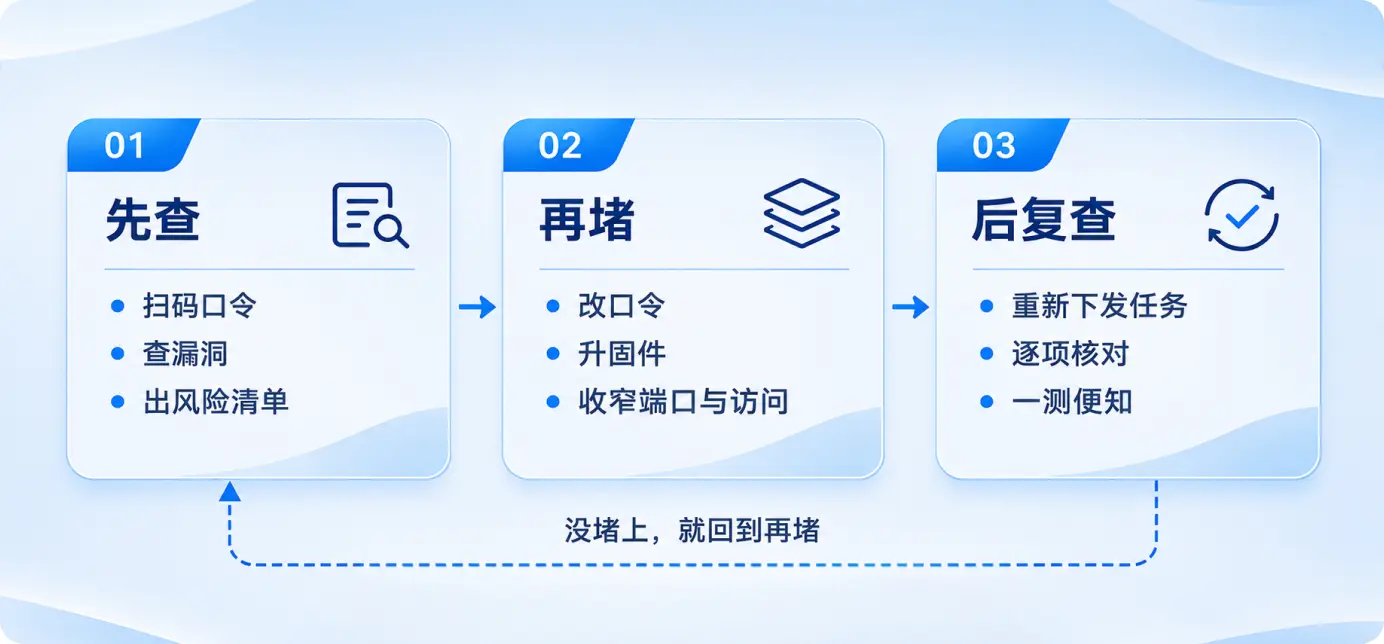
防攻击,是“先查、再堵、后复查”的闭环
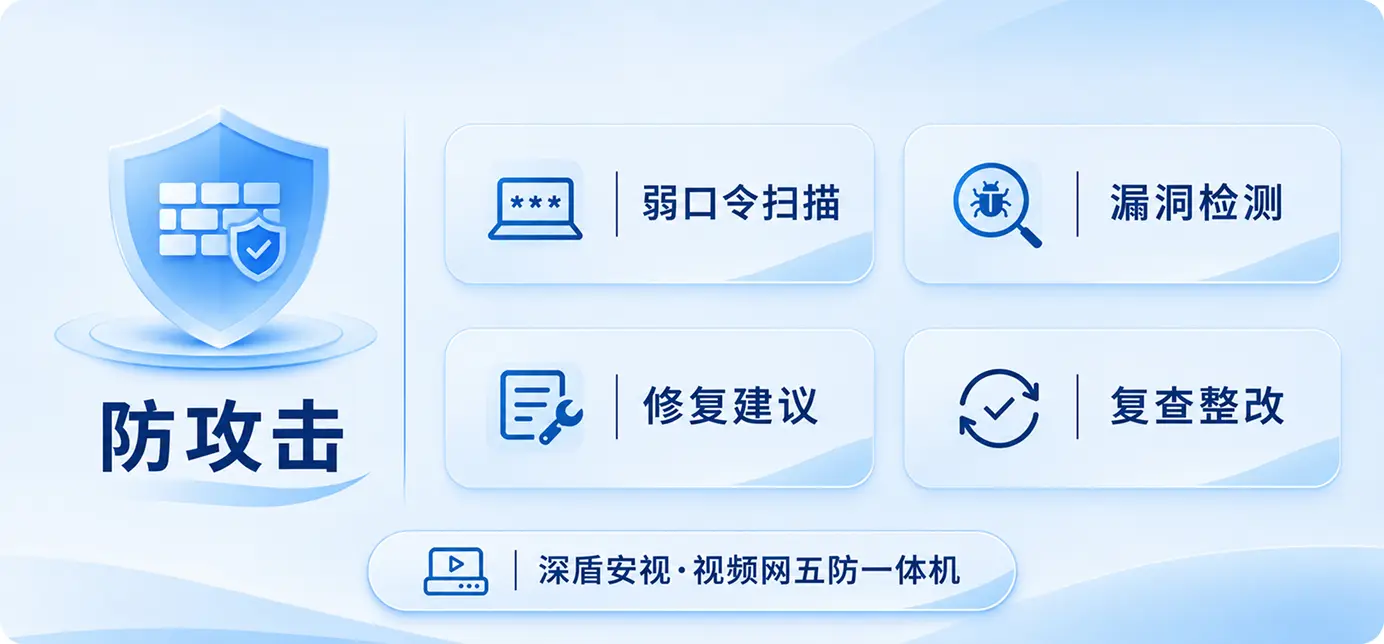
把攻击面查出来,不是扫一次就完事,它是一套“先查、再堵、后复查”的闭环。深盾安视把它做进了视频网五防一体机里:以任务式扫描为核心,把弱口令扫描、漏洞检测、攻击面收敛这些能力整合在一台设备上,作为“防攻击”这一防的底座。
以任务式扫描为核心,对全网视频设备做安全检查:弱口令扫描按协议、端口设定策略,内置可维护的弱口令字典,扫出哪些设备还在用出厂口令;漏洞检测面向视频网设备开展,能定位到具体受影响的设备,给出漏洞详情和修复建议。扫出来的结果,自动关联资产台账,形成一张“资产—风险—建议”的清单。
清单到手,就知道该干什么:把弱口令改掉,把固件升上去,把不该开放的端口和访问收窄。攻击面收敛了,被利用的机会自然就小了。
整改不是一次性的。重新下发扫描任务,复查整改效果,口令改没改、漏洞补没补、该堵的堵上没有,一测便知。防攻击不是“查一次了事”,而是常查、常堵、常复查。
真正难的不是技术,是时效
视频网防攻击真正难的地方,往往不是不会查,而是来不及查。一个漏洞从被披露到被攻击者利用,中间的窗口可能很短。而视频网里设备多、厂家杂、分布散,靠人工一轮一轮地查、一轮一轮地堵,赶不上攻击的速度。任务式扫描的意义就在这里:把全网批量扫一遍,快速定位问题设备;用内置的修复建议,让管理员立刻知道怎么堵;再用复查任务,确认真的堵上了。
三类场景,三种诉求
三类单位,卡住的地方各不一样:有的缺人,有的要留痕,有的怕折腾。
学校、医院、园区、网点等中小规模视频场所,视频系统不大,但常常没有专职的安全人员,也买不起一整套重型的安防体系。对这类单位来说,防攻击要的不是“配置一个安全团队”,而是一台开箱即用、能把攻击面查清楚、堵上的设备,上线先摸底,把资产和风险摸清,再常态地扫、堵、复查。
派出所、区县一级的视频专网,资产台账和风险清单要随时能调,检查来了能拿出完整记录。防攻击在这里不只是技术活,还是迎检的底气,把“查、堵、复查”的记录沉淀下来,谁来了都能讲清楚这张网的攻击面收敛到什么程度。
能源、交通、楼宇这些行业视频专网,最怕的是为了安全去改网络架构、影响业务。旁路接入、不改现网,是这类场景的硬前提。防攻击的检查和加固,要在不碰现有网络的前提下完成。
三类场景,诉求不一样,但落到防攻击上,是同一件事:先把攻击面查出来,再堵上,然后一直盯住。
防攻击,是五防的第一道门
防攻击是五防的第一道门:先把别人能攻进来的路,一条条找出来、堵上。门关紧了,后面的防入侵、防病毒、防篡改、防泄露,才谈得上。真被问到“五防措施落实得怎么样”的时候,防攻击这一项,就是你能不能答得上的第一道题:攻击面查清楚了没有,弱口令改完了没有,漏洞堵上了没有。答得出,才叫落实。这也是深盾安视做五防一体机的原因:五防不是五件独立的事,而是一条链,防攻击是这条链的起点。
Video Network Attack Prevention | Identify the Attack Surface First, Then Close the Gaps
A question frequently raised to video system administrators is: “How well have you implemented the five prevention measures?”The “five preventions” refer to five technical measures stipulated in Article 15 of the Regulations on the Administration of Public Security Video Image Information Systems: anti-attack, anti-intrusion, anti-virus, anti-tampering and anti-leakage. The Provisions on the Supervision and Administration of Public Security Video Image Information Systems issued by the Ministry of Public Security (Gong Tong Zi [2025] No.11) also includes the completeness of these five measures as a mandatory inspection item.These are not empty slogans; each corresponds to a real vulnerability on the network.In many cases, video network breaches stem not from sophisticated attackers, but from numerous unsecured openings across the network. Thousands of cameras and NVRs are deployed on poles, in underground utility tunnels, and in remote corners of equipment rooms, often with unchanged default passwords, outdated firmware, and exposed ports. Attackers can gain access simply by scanning the network.Therefore, the first step for video network attack prevention is not interception, but identifying the attack surface.
The Attack Surface Is Often Exposed
The attack surface of video networks mainly lies in three areas:
Weak passwords: A large number of cameras and NVRs go online with factory default passwords that are never changed after deployment, such as 123456, admin and other default credentials. This is not merely a vulnerability — it is an unlocked door. Attackers can scan and log into batches of devices to obtain administrative privileges.
Vulnerabilities: Camera firmware updates are often delayed, leaving publicly known vulnerabilities in old versions. Vendors may have released patches long ago, yet devices deployed in the field, on poles or in unattended equipment rooms remain un-updated, leaving vulnerabilities open for exploitation.
Unclear network boundaries: Administrators often lack a clear inventory of connected devices, their types, open ports and interconnections. After reconnaissance, attackers may know the network better than its operators.
These three risks share one thing in common: they can be detected and remediated in advance instead of waiting for a security incident. The first line of defense for video network security is to map out the attack surface proactively, rather than responding after an attack.

Attack Prevention Forms a Closed Loop: Detect, Remediate, and Re-verify
Mapping the attack surface is not a one-time scan; it follows a closed loop of detection, remediation and re-verification. SENDUN Anshi integrates this workflow into its All-in-One Five-Prevention Appliance for Video Networks. Centered on task-based scanning, the device consolidates weak password scanning, vulnerability detection and attack surface reduction to serve as the foundation for anti-attack protection.
Task-based scanning performs security inspections across all video devices on the network. Weak password scanning adopts configurable policies by protocol and port, with a maintainable built-in weak password dictionary to identify devices still using factory defaults. Vulnerability scanning targets video network hardware, pinpoints affected devices and provides vulnerability details and remediation guidance. Scan results are automatically linked to the asset inventory to generate an asset-risk-recommendation checklist.
With the checklist in hand, administrators can reset weak passwords, upgrade firmware, and restrict unnecessary open ports and access. As the attack surface shrinks, the chance of exploitation drops accordingly.
Remediation is not a one-off job. New scanning tasks can be scheduled to verify whether passwords have been reset, vulnerabilities patched and access gaps closed. Attack prevention requires continuous scanning, remediation and validation, not a single check.

The Real Challenge Lies in Timeliness, Not Technology
The biggest challenge for video network attack prevention is often the lack of time for response, rather than the lack of technical capability. The window between vulnerability disclosure and exploitation can be very short. Video networks feature massive, multi-vendor, widely dispersed devices; manual cyclic scanning and remediation cannot keep pace with attackers.This is the value of task-based scanning: it bulk-scans the whole network to quickly locate problematic devices, provides built-in remediation guidance for administrators, and runs follow-up verification tasks to confirm that risks have been closed.
Three Scenarios, Three Sets of Requirements
Different organizations face distinct bottlenecks: some lack dedicated staff, some require audit trails, and others cannot tolerate network disruptions.
Small and medium-scale video deployments such as schools, hospitals, campuses and service outlets usually have limited video infrastructure, no full-time security personnel and cannot afford heavyweight security suites. For these users, attack prevention does not mean building a dedicated security team. Instead, they need a plug-and-play appliance to discover and mitigate the attack surface: inventory assets and risks upon deployment, then maintain regular scanning, remediation and verification.
For police stations and district/county-level private video networks, asset inventories and risk lists must be readily available with complete records for inspections. Attack prevention here is not merely technical work, but also provides audit readiness. Records of detection, remediation and re-verification are retained to demonstrate how the attack surface has been reduced during audits.Industrial private video networks in energy, transportation and building sectors prioritize business continuity and resist changes to the existing network architecture. Passive side-deployment without altering the live network is a hard requirement. Security scanning and hardening must be performed without interfering with the operational network.While the three scenarios have different priorities, they share the same core principle for attack prevention: identify the attack surface, close the gaps, and maintain continuous monitoring.
Anti-Attack Is the First Gate of the Five Preventions
Anti-attack serves as the first gate among the five preventions: every potential entry path for attackers must be identified and closed one by one. Only after this gate is secured can anti-intrusion, anti-virus, anti-tampering and anti-leakage controls function effectively.When auditors ask “how well have you implemented the five prevention measures”, anti-attack is the first question to answer: whether the attack surface has been mapped, weak passwords reset, and vulnerabilities patched. Clear answers prove proper implementation.This is the rationale behind SENDUN Anshi’s Five-Prevention All-in-One Appliance: the five preventions are not isolated controls, but a connected chain, with anti-attack as its starting point.