


 2026-11-02

2025年4月1日,国务院令第799号《公共安全视频图像信息系统管理条例》正式施行。条例第十四条要求,公共安全视频系统管理单位应当在系统投入使用之日起30日内向所在地县级人民政府公安机关备案;第十五条要求管理单位完善防攻击、防入侵、防病毒、防篡改、防泄露等安全技术措施,确保视频图像信息的原始完整。与之并行的等保2.0“一个中心、三重防护”核心标准架构中,安全区域边界与安全计算环境同样有硬性控制项。几个角度最后都落到同一个问题:这张网上,到底谁可以接进来?
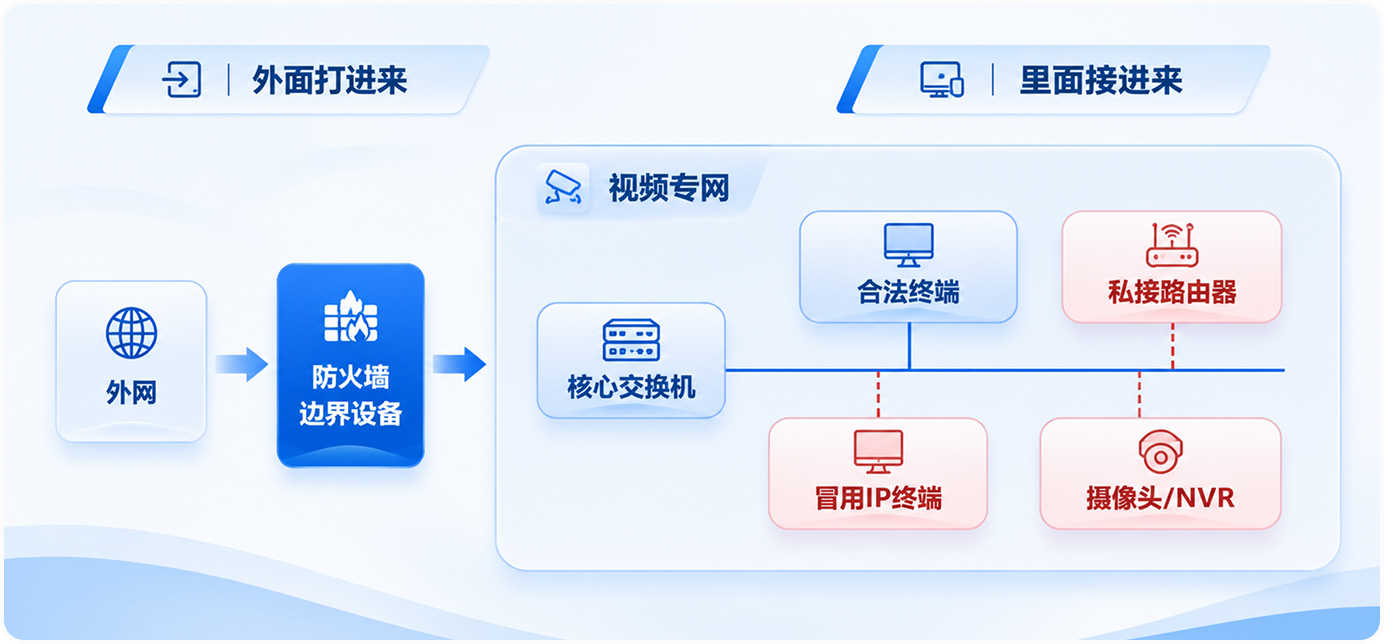
过去谈边界安全,注意力大多放在“外面打进来”,但在一线运维里更常见的风险是“里面接进来”。项目中经常会听到这几个问题:网里接入了什么设备?设备在哪里?谁在使用?安全性怎么样?私接的路由器能绕过外围防护,冒用IP的笔记本在日志里和合法终端看不出区别,摄像头、NVR这类终端既不装客户端也不在台账里,这些都不是网络层能看见的问题。防火墙很少缺,缺的是这个答案。
守门的产品,自身也要先过合规这一关。799号令第十二条规定,公共安全视频系统采用的产品、服务,应当符合国家标准的强制性要求。《网络安全法》第二十三条要求,网络关键设备和网络安全专用产品,须经具备资格的机构安全检测符合要求后方可销售或提供。《网络关键设备和网络安全专用产品目录》(2023年第2号)中,“终端接入控制产品”被列为网络安全专用产品:提供对接入网络的终端进行访问控制功能的产品。网络安全专用产品的检测依据,是强制性国家标准GB 42250-2022《信息安全技术 网络安全专用产品安全技术要求》,该标准2022年12月29日发布、2023年7月1日实施。近期,深盾安视网络接入控制系统顺利通过公安部计算机信息系统安全产品质量监督检验中心安全检测,获得《网络安全专用产品安全检测证书》。合规前提已经具备,选型也多了一条标尺。
深盾安视网络接入控制系统秉承“违规不入网,入网必合规”的网络安全管理目标设计,主要解决“网络接入不可知、非法外联不可控、违规行为不可管”三类问题。它的工作流程只有五步,且不需要改动现有网络架构:
1.通过镜像数据分析终端的网络访问请求;
2.分析访问请求的IP地址是否在当前安全IP列表中;
3.不在安全IP列表中的终端将被阻断通信;
4.阻断通信的同时,将通过WEB界面提示安装深盾安视客户端,安装完成后系统将自动对当前登录设备进行体检,如体检不合格将阻止入网,并提供修复提示。
5.体检合格或修复完成,系统将放行此IP入网。
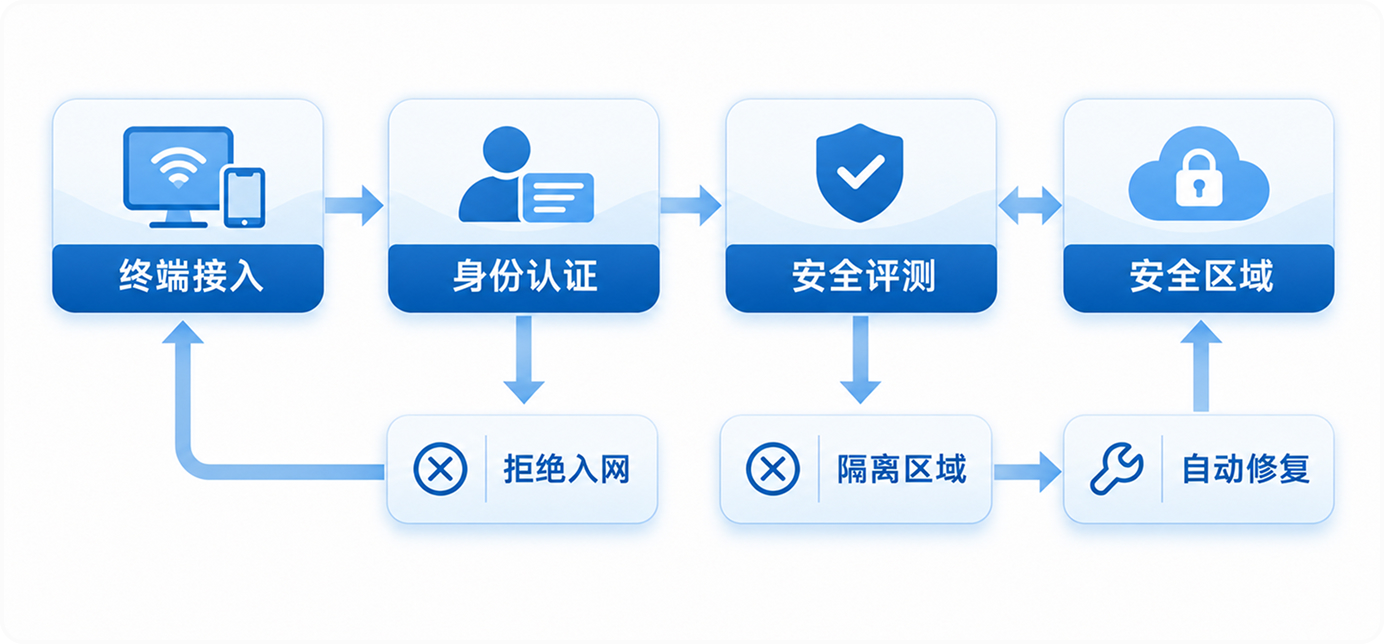
支撑这套流程的是四项能力,覆盖等保的身份鉴别、入侵防范、边界防护、访问控制与安全审计要求。
身份鉴别——支持口令、AD域、LDAP、邮箱、短信、CA证书、USB Key认证方式,可将两种以上组合为双因子认证,从源头确保接入终端和人员的合法性。
安全测评——入网前对终端自动体检,覆盖网络安全(AD域环境、Telnet检测、IP/MAC绑定、网络监听端口、ARP欺骗)、主机安全(远程桌面、恶意代码防范、防火墙、超时锁屏、系统服务、系统时间、共享资源、操作系统补丁)、口令安全(黑名单口令、口令安全检测、来宾用户)、应用安全(红名单、黑名单程序)。不合格终端进入隔离区,支持在线测评与一键修复。
违规报警与处置——对违规外联、硬件变化、操作系统漏洞、恶意代码防范等情况实时报警。处置手段包括将违规终端移入隔离区阻断网络权限、锁定终端屏幕或强制关闭计算机,并可发送报警邮件、手机短信和桌面弹窗通知管理员。
权限控制与审计——以单个用户为粒度划分网络隔离域、来宾可见域、网络安全域和终端用户域,支持按部门设置不同访问范围;网络设备自动发现并自动绘制拓扑,违规接入终端在拓扑图中通过上联交换机颜色报警定位,可发现终端私接路由并报警,通过设备背板迅速定位异常终端位置;报表覆盖在线状态、违规报警、入网状态、测评状态、资产统计、行为审计六类。
上述能力对网络无任何要求,无缝兼容现有网络所有设备,不改变网络物理及逻辑拓扑结构,兼容LAN、WLAN、Wi-Fi、NAT、VPN等各种网络环境,支持IPv6环境;支持BYPASS、分级级联部署、双机热备等高可用性部署方式。所有功能通过一个服务器平台、一个管理页面、一个终端插件实现。
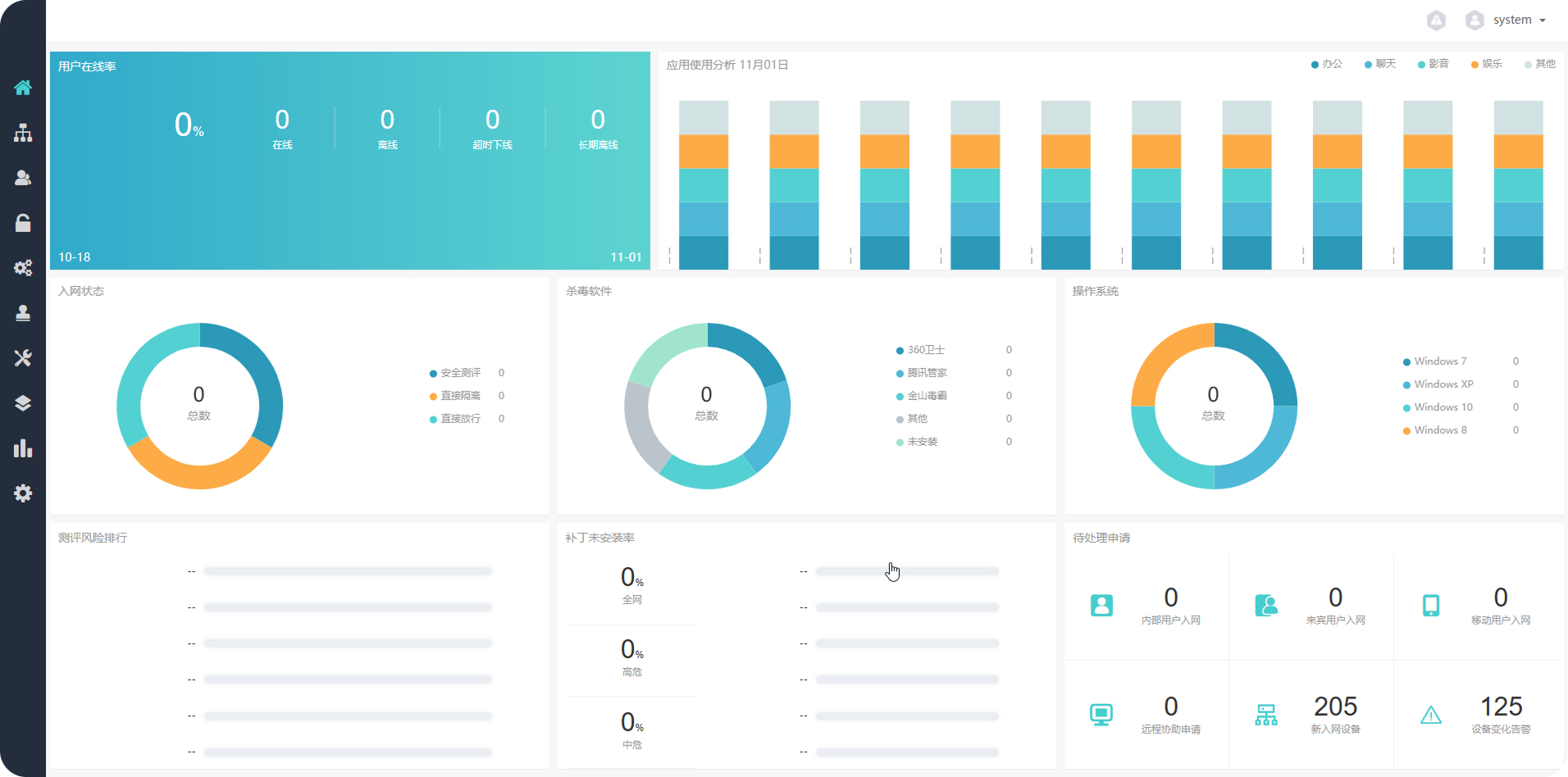
这套做法已有落地实例。某省监狱管理局推进全省监狱等保建设时,把各监狱的准入设备级联至管理局,统一制定策略、同步下发,全网执行同一套入网基线,覆盖全省数万台办公终端。终端接入前须通过身份认证和杀毒软件检测,未装指定杀毒软件的拦在网外;违规外联即时阻断,日志留存可查。管理局侧通过级联页面即可查看各监狱的策略、设备、资产与网络架构,全省接入情况集中在一处。
合规比的不是谁买的设备多,而是谁能说清三件事:谁可以接入、接入之后能做什么、做过的事留没留痕。799号令第十六条要求采取授权管理、访问控制等技术措施,等保2.0在安全区域边界也要求访问控制。一个是行政法规,一个是国家标准,落点却是同一个动作:谁能进来。深盾安视的网络接入控制系统,愿意做这道关口上的那扇门。
On April 1, 2025, Order No. 799 of the State Council, the Regulations on the Administration of Public Security Video Image Information Systems, came into force. Article 14 of the Regulations stipulates that the administrative unit of a public security video system shall file the system with the public security organ of the people’s government at the county level at the place where it is located within 30 days from the date the system is put into use. Article 15 requires the administrative unit to improve security technical measures such as anti-attack, anti-intrusion, anti-virus, anti-tampering and anti-leakage to ensure the originality and integrity of video image information. In parallel with this, the core standard architecture of “One Center, Three Lines of Protection” under Classified Protection of Cybersecurity Version 2.0 also contains mandatory control items for security zone boundaries and secure computing environments. Multiple perspectives ultimately converge on one core question: Who is allowed to access this network?
In the past, boundary security mainly focused on external attacks breaking into the network. However, in frontline operation and maintenance, a more prevalent risk comes from internal unauthorized access. Several questions frequently arise in projects: What devices are connected to the network? Where are these devices located? Who is using them? How secure are they? Privately connected routers can bypass peripheral protection measures. Laptops with spoofed IP addresses are indistinguishable from legitimate terminals in logs. Terminals such as cameras and NVRs are neither equipped with client software nor recorded in asset ledgers. These are issues that cannot be identified merely at the network layer. Firewalls are widely deployed, yet the answer to the above questions is often missing.
Products deployed as network gatekeepers must themselves meet compliance requirements first. Article 12 of Order No.799 specifies that products and services adopted by public security video systems shall comply with the mandatory requirements of national standards. Article 23 of the Cybersecurity Law of the People’s Republic of China requires that critical network equipment and special cybersecurity products can only be sold or provided after passing security testing by qualified institutions. In the Catalogue of Critical Network Equipment and Special Cybersecurity Products (Announcement No.2, 2023), “Terminal Access Control Products” are classified as special cybersecurity products, defined as products providing access control functions for terminals accessing the network. The mandatory national standard governing testing for special cybersecurity products is GB 42250-2022 Information Security Technology — Security Technical Requirements for Special Cybersecurity Products, issued on December 29, 2022 and implemented on July 1, 2023. Recently, the DeepShield Vision Network Access Control System has successfully passed security testing conducted by the Computer Information System Security Product Quality Supervision and Inspection Center of the Ministry of Public Security and obtained the Security Testing Certificate for Special Cybersecurity Products. With compliance prerequisites fulfilled, a new benchmark is available for product selection.
Designed around the security management goal of “No Unauthorized Access; All Access Compliant”, the DeepShield Vision Network Access Control System mainly addresses three challenges: unknown network access, uncontrollable unauthorized external connection, and unmanageable non-compliant behaviors. Its workflow consists of only five steps and requires no modification to the existing network architecture:
1.Analyze terminal network access requests through mirrored traffic data;
2.Check whether the IP address of the access request is in the trusted IP list;
3.Terminals with IP addresses outside the trusted list will have their communications blocked;
4.While communications are blocked, a web prompt will guide users to install the DeepShield Vision client. After installation, the system will automatically run a security assessment on the current device. If the assessment fails, network access will be denied with remediation guidance provided;
5.Network access will be granted once the assessment passes or remediation is completed.
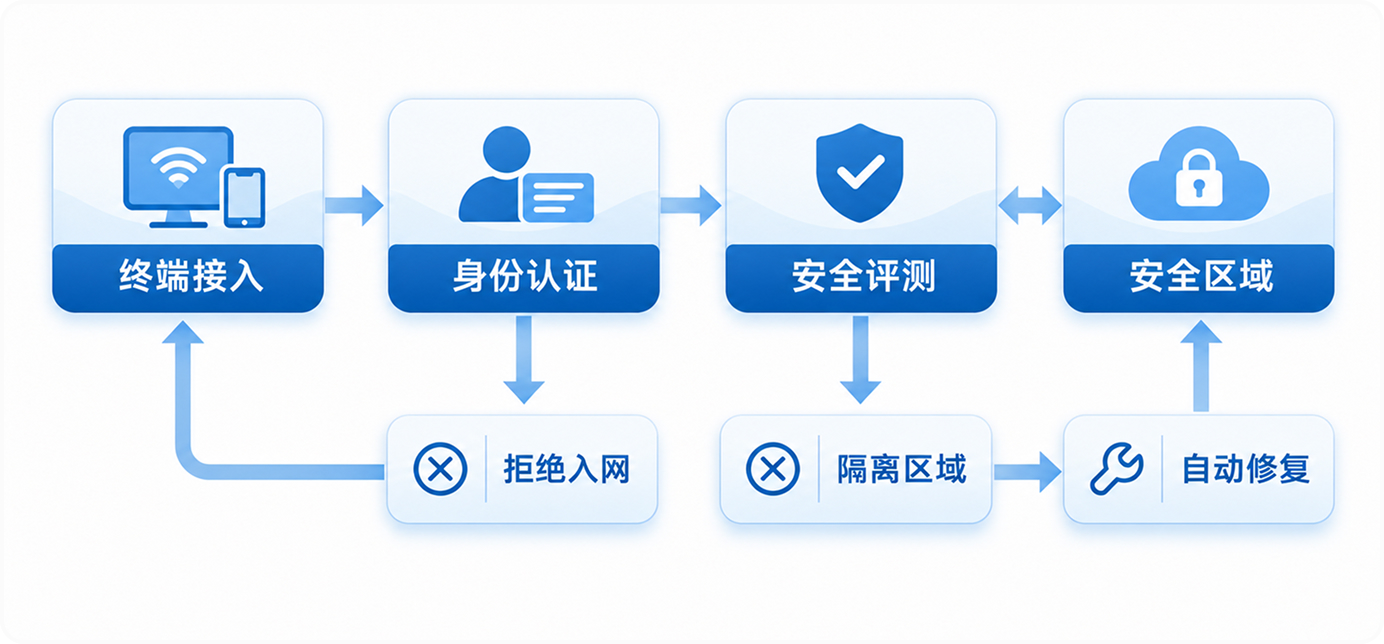
This workflow is supported by four core capabilities, covering the requirements of identity authentication, intrusion prevention, boundary protection, access control and security audit specified in classified protection standards.
Identity Authentication — Supports password, AD domain, LDAP, email, SMS, CA certificate and USB Key authentication. Two or more methods can be combined to implement two-factor authentication, verifying the legitimacy of accessing terminals and users from the source.
Security Assessment — Automatically runs pre-access terminal security checks covering network security (AD domain environment, Telnet detection, IP/MAC binding, network listening ports, ARP spoofing), host security (remote desktop, malware prevention, host firewall, idle screen lock, system services, system time, shared resources, OS patches), password security (password blacklist, password strength inspection, guest account status), and application security (program whitelist and blacklist). Non-compliant terminals are isolated, with online assessment and one-click remediation supported.
Non-compliance Alarm & Response — Real-time alerts for unauthorized external connections, hardware changes, OS vulnerabilities and malware risks. Response actions include isolating non-compliant terminals to block network permissions, locking terminal screens or forcing computer shutdown. Notification can be delivered to administrators via alert emails, SMS and desktop pop-ups.
Permission Control & Audit — Divides the network into isolated security domains, guest-accessible domains, network security domains and end-user domains at individual-user granularity, with customizable access scopes by department. The system automatically discovers network devices and generates network topologies. Non-compliant access terminals are highlighted by color-coded uplink switches on the topology map for rapid location. It can detect and alert on privately connected routers, and pinpoint abnormal terminals via switch backplane information. Audit reports cover six categories: online status, non-compliance alarms, network access status, assessment status, asset statistics and behavior logs.
The above capabilities impose no special prerequisites on the network. The system seamlessly interoperates with all existing network equipment without altering physical or logical network topologies. It is compatible with LAN, WLAN, Wi-Fi, NAT, VPN and IPv6 environments. High-availability deployment modes including BYPASS, hierarchical cascading and active-standby redundancy are supported. All functions are delivered via one server platform, one management portal and one lightweight terminal plugin.
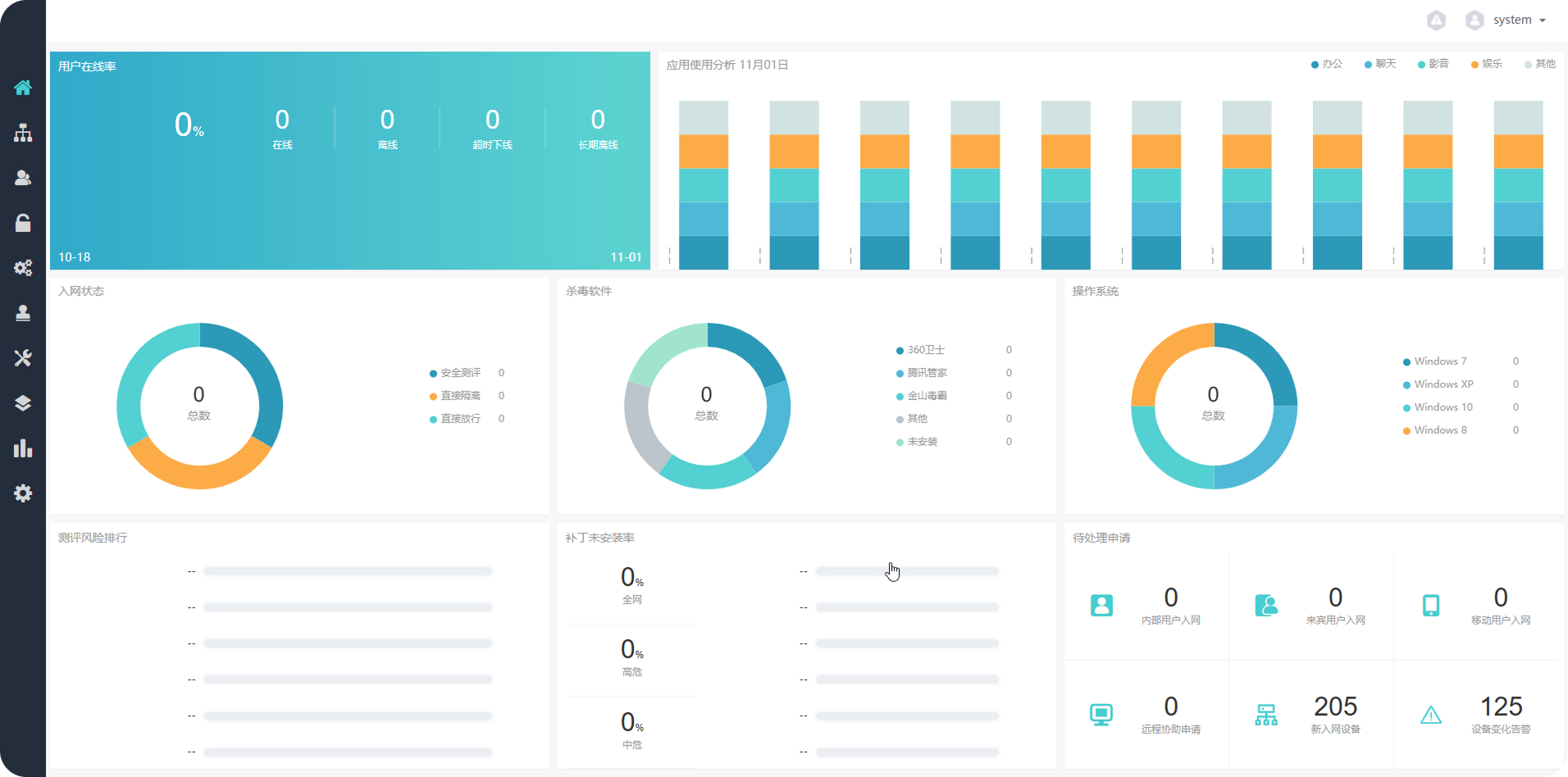
This solution has been deployed in real-world projects. When the Prison Administration Bureau of a province rolled out classified cybersecurity protection construction across all local prisons, access control devices of each prison were cascaded to the provincial bureau. Unified security policies were formulated and distributed to enforce identical network access baselines across the whole network, covering tens of thousands of office terminals province-wide. Terminals must pass identity authentication and antivirus inspection before access; terminals without specified antivirus software are blocked. Unauthorized external connections are blocked instantly with retained traceable logs. Administrators at the provincial bureau can view policies, devices, assets and network architectures of all prisons from the cascaded management portal, with full network access status centralized in a single pane of glass.
Compliance is not measured by the quantity of purchased devices, but by the ability to clearly answer three questions: Who is permitted to access the network? What can authorized users do after access? Are all operations logged for traceability? Article 16 of Order No.799 mandates technical measures such as authorization management and access control, while Classified Protection 2.0 also requires access control at security zone boundaries. One is an administrative regulation and the other a national standard, yet both target the same core control: who may enter the network. The DeepShield Vision Network Access Control System serves as the gate at this critical checkpoint.

